
Battery sealing
Water in a high-voltage pack is a fire, not a fault. Housings resealed and pressure-tested before they go back.
When to have it looked at
- Coolant level dropping with no visible leak anywhere.
- Isolation faults that come and go with the weather.
- A pack that has been off the car, or a vehicle that has been through deep water.
Why it fails
A high-voltage pack is sealed against water because water inside it is a fire, not a fault. Seals age, housings distort after an impact, and a pack that has been opened once and closed without new seals will let moisture in slowly. Nothing about that is visible from outside, which is why sealing is tested with pressure rather than inspected by eye.
How we work
- We record the condition in writing before anything is opened, and you get a copy.
- The unit is stripped and inspected. It is the only way to know the real state of it.
- Everything that matters is measured, not estimated.
- You get a written quote before any repair starts. Nothing proceeds without your agreement.
- We replace what has actually failed and what will fail next, not the whole assembly.
- It is tested under load and returned to you with the findings written up.
What decides the price
What moves the price is the platform, what we find once it is open — which nobody can know beforehand — and whether the original parts can be reused. That is why the quote comes after the inspection and not before it.
Turnaround, warranty and whether a teardown is chargeable are set by this workshop. Ask us before you commit.
Resealing: moisture is the thing that kills packs
Cars regularly arrive past 300,000 km on their original pack, and some past 600,000. They get there by not sitting in moisture. Every damaged cell, degraded module and disturbed pack we have examined traces back to water, ingress or overheating from a climate system that was not working.
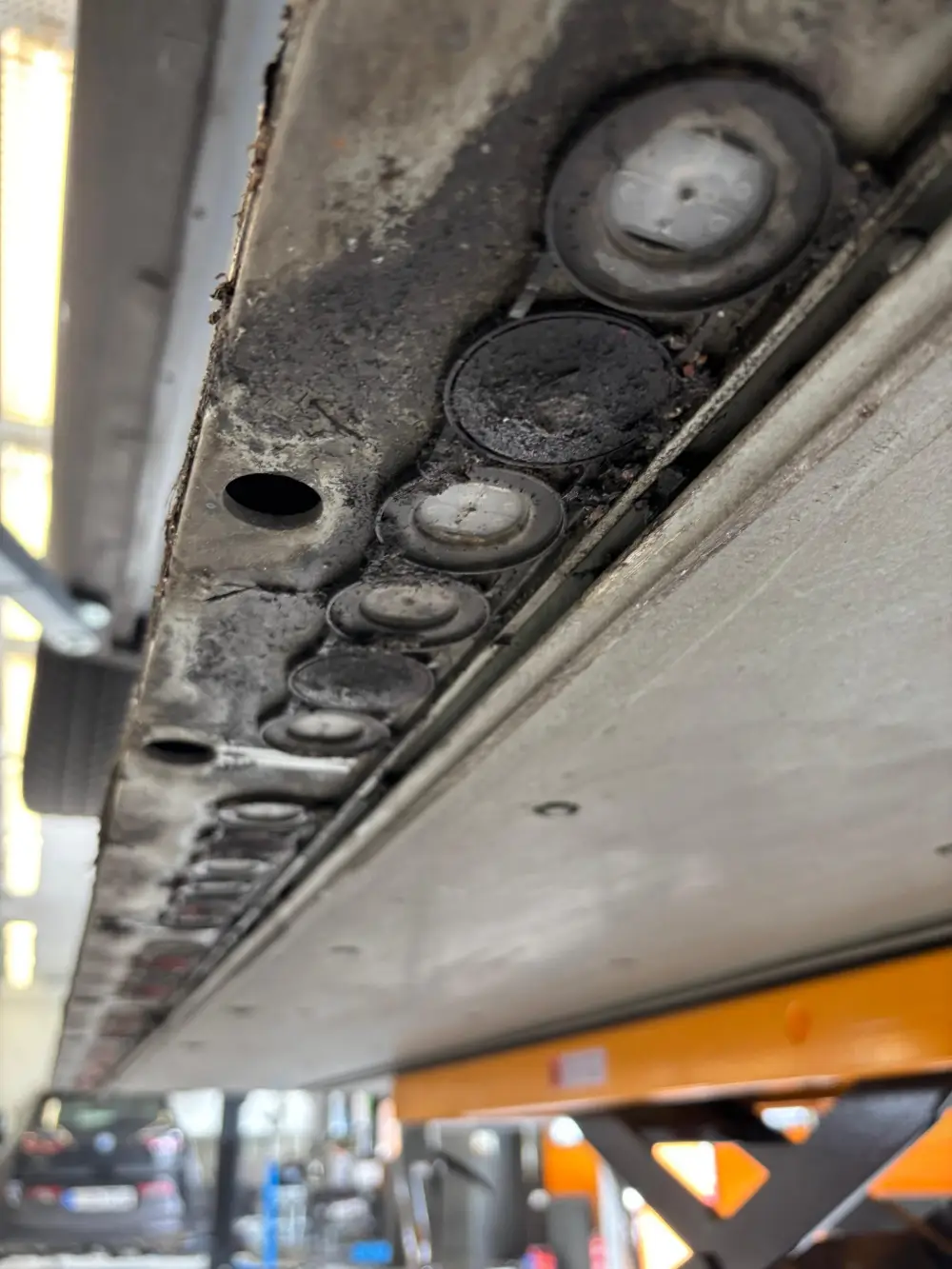
What five years of a bad valve does
One pack had a damaged pressure equalisation valve in the first block. Moisture came in through it for five or six years. That module degraded five per cent further than the others and damaged the wiring inside itself as well. The pattern repeats: for cylindrical cells, moisture is enemy number one.
Where it gets in
- Pressure equalisation valves that have aged or been damaged.
- On the first series, the fuse cover on the top of the pack, which oxidises until it lets water past. After that it only takes a heavy rainfall.
- Sealing along the flange, which is not eternal and was never meant to be.
Why a supercharger hides it
Owners with unnoticed ingress sometimes avoid system faults by fast-charging often: the heat drives some of the moisture out. It also raises overall degradation of the pack by three to eight per cent. The fault is being masked, not fixed, and paid for in capacity.
Do it before, not after
Resealing every four to six years is preventive maintenance in the ordinary sense of the term: it costs a fraction of the overhaul it avoids, and the faults it prevents — isolation faults, corroded sense wires — are exactly the ones that are expensive to chase once they have started.
Fault codes on this page
BMS_w123BMS_f107
Vehicles this applies to
Tesla Model S and Model X, first series 2012–2015 especially
What we have written about this
- Tesla LDU “coolant delete” fatal failures evclinic.eu
- EQC ZF eDrive repetative failure – SiC seal wrong technology evclinic.eu
- Fiat 500e, 2020 model – electric motor failure due to coolant intrusion. evclinic.eu
- Opel Ampera 2013 – Neglected omission on coolant sensor evclinic.eu
- Part 1 – S85 battery refurbish – Water ingress evclinic.eu
- eTron APA250 eDrive HolyGrail PTFE Seal install evclinic.eu
Book Battery sealing, or ask us about it first.