
Module and cell replacement
Modules and individual cells, matched by capacity and internal resistance so the new part does not age faster than the old.
When to have it looked at
- A persistent cell imbalance that balancing will not clear.
- Physical damage, corrosion or heat marks on one module.
- A pack that has been opened before and never matched properly.
Why it fails
A replacement module has to match the ones around it in capacity and internal resistance, not just in part number. Fit a stronger one and it carries the others; fit a weaker one and it becomes the new limit. Either way the pack ages around the mismatch, which is why matched replacement is the whole job.
How we work
- We record the condition in writing before anything is opened, and you get a copy.
- The unit is stripped and inspected. It is the only way to know the real state of it.
- Everything that matters is measured, not estimated.
- You get a written quote before any repair starts. Nothing proceeds without your agreement.
- We replace what has actually failed and what will fail next, not the whole assembly.
- It is tested under load and returned to you with the findings written up.
What decides the price
What moves the price is the platform, what we find once it is open — which nobody can know beforehand — and whether the original parts can be reused. That is why the quote comes after the inspection and not before it.
Turnaround, warranty and whether a teardown is chargeable are set by this workshop. Ask us before you commit.
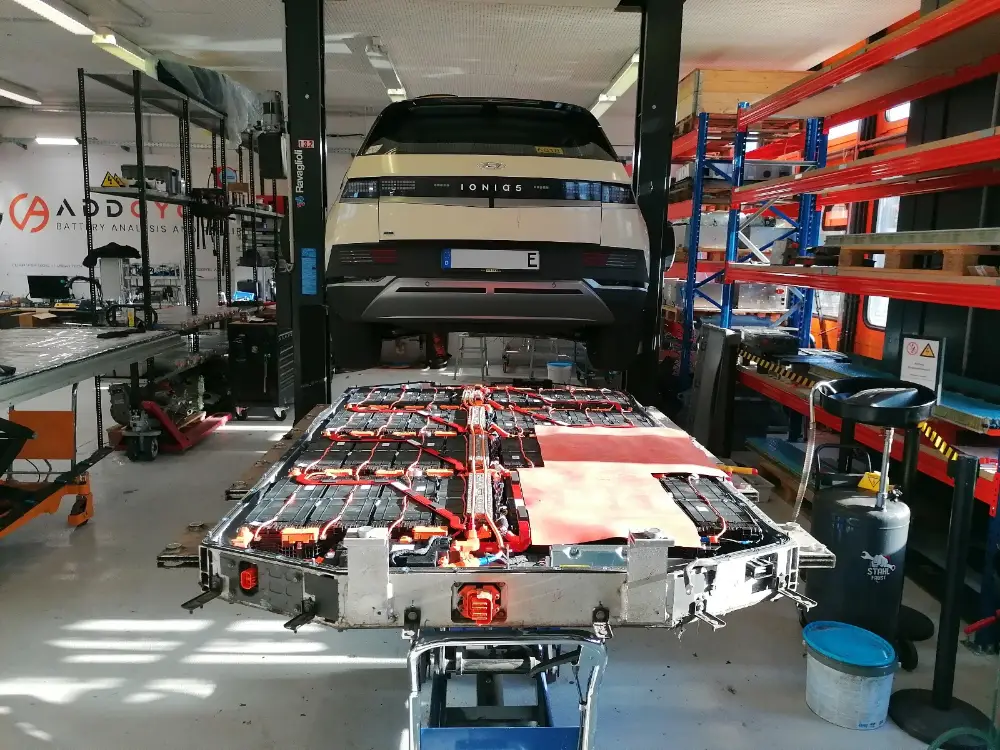
Hyundai Ioniq 5: one module in an 800 V pack
A car arrived with nothing more than a message to check the electrical system, and no clear high-voltage battery codes stored at all. It was a single damaged module, and finding it took measurement rather than a scan tool.
What 800 volts actually changes
The Ioniq 5 runs an 800 V system where most electric cars run around 400. Power is voltage times current, so doubling the voltage roughly halves the current for the same power: less loss in the cables and connectors, thinner cable, less weight, and very high DC charging rates on a charger that can supply them. For the individual cell almost nothing changes — there are simply more of them in series. What heats a cell is its C-rate, its internal resistance and its cooling, not the system voltage of the car around it.
Finding the module
- The pack comes out of the floor of the car.
- Module voltages are compared against each other on the bench. One module sat 300 mV away from the rest.
- That module was then inspected, and showed mechanical damage.
Voltage deviation plus something visible
A measured deviation together with a visible change is a clear finding — either alone is weaker. The module was replaced, the pack rebuilt, the prescribed high-voltage tests carried out, and the message in the car was gone.
Measuring a cell properly
Impedance spectroscopy measures a cell's impedance across a range of frequencies, and from that you can reason about internal resistance, diffusion and ageing. The point is to identify modules and cells that are already weak, before they misbehave on the road or trip a fault in the battery management system. On a pack as complex as this one that makes a repair far more targeted.
Is this a pattern?
Not something anybody can answer honestly yet: too few cases, and the cars are still young. What can be said is that individual module faults occur here as they do at every other manufacturer, that systematic measurement tells you far more about a pack than the messages on the dashboard, and that this traction battery repairs well.
Vehicles this applies to
Hyundai Ioniq 5, Kia EV6 and the E-GMP platform
What we have written about this
- Extreme NMC Cell damage – No fire! evclinic.eu
- Real cell recycling – circular economy withing repair process evclinic.eu
- Tesla single-cell swap is possible evclinic.eu
- Tesla Battery “Recycling” in 64 kW Solar UPS system evclinic.eu
- Tesla S / X Module Bench Diag evclinic.eu
Related parts and services in the shop
- Actuator Box XS 12 ext. Module evclinic.eu
Book Module and cell replacement, or ask us about it first.